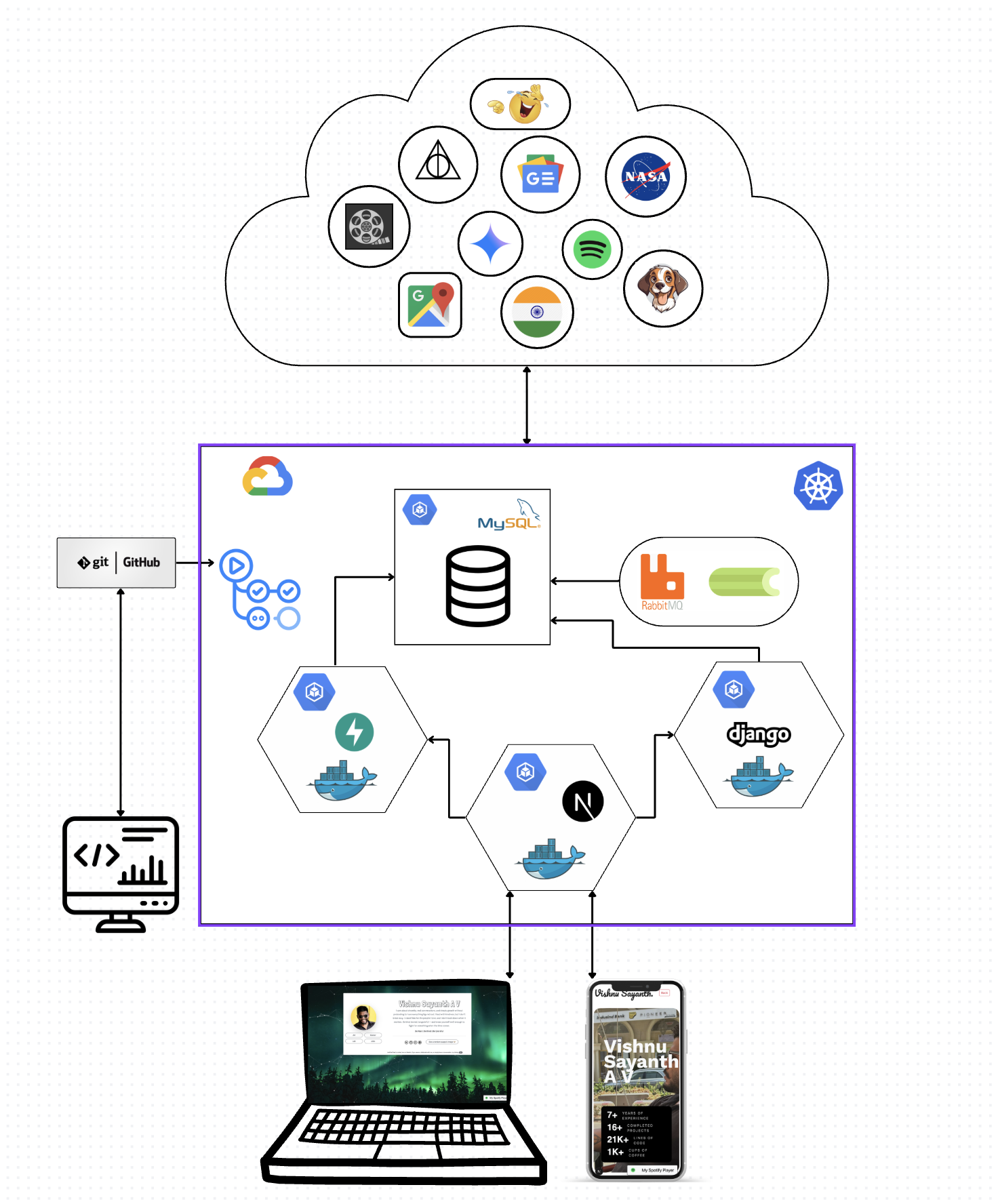
1. Architecture Overview
The system is designed as a cloud-native, containerized platform. Backend services are deployed on Kubernetes and exposed through a unified API layer consumed by web clients.
2. System Overview
The platform aggregates multiple public APIs (NASA, Harry Potter, Gemini, OMDb, Maps, etc.) into a centralized backend. All external integrations are normalized and exposed through structured REST endpoints consumed by a Next.js frontend.
Core services run inside Docker containers orchestrated by Kubernetes. MySQL acts as the relational datastore, while Celery and RabbitMQ handle asynchronous and scheduled workloads.
3. Technology Stack
Backend
The backend layer is implemented primarily in Python, combining synchronous and asynchronous services for flexibility and performance.
- Python – primary backend language
- Django – orchestration layer and admin APIs
- FastAPI – async microservices and experimental routes
- Celery + RabbitMQ – background processing
- MySQL – relational data store
- Django ORM / Tortoise ORM – database abstraction layers
Frontend
The client layer is built using a React-based architecture optimized for responsive web usage.
- Next.js – application framework
- React – UI composition and state management
- REST/JSON integration with backend services
Infrastructure
The platform is fully containerized and deployed using a modern CI/CD workflow.
- Docker – service containerization
- Kubernetes – orchestration and scaling
- Google Cloud – compute and networking
- GitHub Actions – automated build and deployment pipeline
- Nginx / Ingress – HTTP routing layer
4. Core Services
Django Core Service
Acts as the primary API and orchestration layer for internal models and administrative functionality.
- User authentication and management
- CRUD APIs
- Administrative dashboards
- Celery task orchestration
FastAPI Services
Provides lightweight, high-performance async endpoints for external integrations and experimental modules.
- Async external API calls
- Response transformation and aggregation
- Frontend-facing JSON endpoints
Celery + RabbitMQ
Background task layer used to offload long-running or I/O-heavy operations from the HTTP request lifecycle.
- Scheduled synchronization jobs
- Data enrichment and caching
- Heavy processing tasks
5. Deployment & CI/CD
The platform follows a container-based deployment strategy with automated build and release workflows.
- Source code managed in GitHub
- GitHub Actions builds Docker images
- Images deployed to Kubernetes cluster
- Kubernetes manages scaling and health checks
6. External Integrations
Multiple public APIs are integrated to provide data-rich modules within the platform.
- NASA APIs (APOD, NEO, imagery)
- Harry Potter metadata APIs
- Gemini / GenAI features
- OMDb movie data
- Maps and geolocation services
- Dogs & Jokes APIs (utility modules)
All external calls are routed through backend services for authentication, normalization and rate limiting.
7. Architecture Diagram
The diagram below illustrates the high-level interaction between clients, backend services, messaging systems, databases and external APIs.